
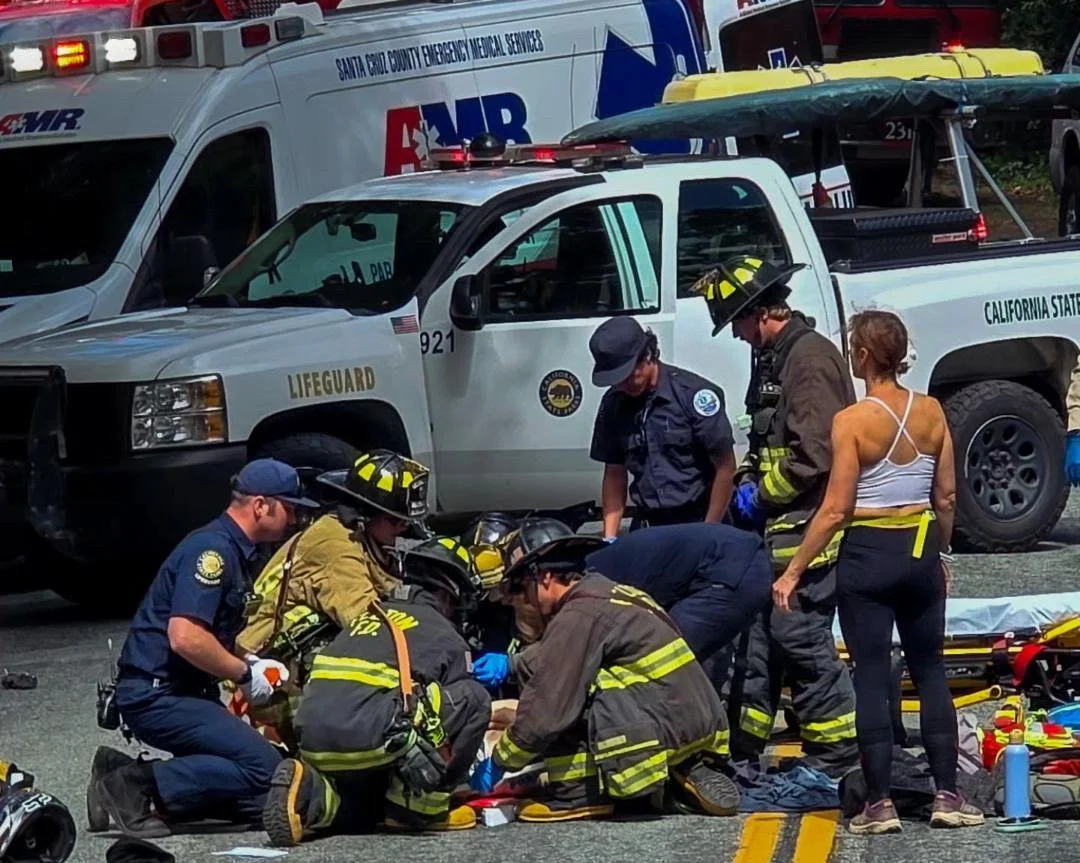
The Forgotten First Responder
California's open water lifeguards are the first trained responder on scene to drownings, cardiac arrests, and coastal traffic collisions. They are not recognized as first responders in California statute. We are asking the Legislature to change that.
If you're a lifeguard, a beachgoer, or a Californian, here is the work.
The more agencies, associations, and individual residents who contact their representatives, the harder this is to ignore. The goal is for this to look like what it actually is: a statewide call from every coastal community in California.
Email your legislator in five minutes.
Find your representative at findyourrep.legislature.ca.gov. Paste this into your email, fill in the highlighted blanks, and send.
We are two California lifeguards who could not stay quiet about this any longer.
This effort is not coming from a lobbyist, a consultant, or a think tank. It is coming from two working lifeguards who love this profession, love the people in it, and decided it was time to do something about the gap between what we do and what California has been willing to call it.
Gisele is a California State Parks lifeguard out of the Angeles District and the president of the Malibu Coast Surf Lifesaving Association. She recently graduated from UC Berkeley with a degree in neuroscience and is currently conducting research at UCLA during her gap year before applying to MD/PhD programs. She loves the lifeguards and the lifeguarding community, and has always wanted the chance to advocate on their behalf. It is an honor to serve her lifeguard brethren in a meaningful way.
Caleb is a California State Parks lifeguard out of the Training Sector, with eleven seasons on the job. He holds a Master's in Clinical Counseling and Psychology, and brings that lens to everything from peer wellness to how this campaign frames the people inside it. Caleb loves this workforce and is in this fight because he believes the lifeguards he works alongside deserve every protection, every benefit, and every ounce of recognition this state has ever extended to a first responder.
The "forgotten first responder" is not a metaphor. It is the situation, as it currently stands.
Open water lifeguards are sometimes called the forgotten first responders. Not because the work is unseen, but because the recognition of that work has not kept pace with the reality of what we do every shift. We perform duties identical to those of every other recognized emergency response classification in California, and we have still not been named as first responders in California statute. We carry the duty without the recognition, and without the statutory protections, benefits, and emergency planning inclusion that designation provides.
This is not a request to create a new category of worker. It is not a request to write new law. It is a request that California name what the work already is. On April 8, 2026, the Hawaiʻi State Legislature adopted Senate Resolution 54 and Senate Concurrent Resolution 56, recognizing open water lifeguards as first responders, with zero dissenting committee votes. California now has the opportunity to do the same.
We are respectfully urging the Legislature to consider a concurrent resolution formally recognizing California's open water lifeguards as first responders and emergency response providers. This is the first step. It does not change labor law. It does not create new benefits overnight. What it does do is lay the foundation for every future piece of work that follows. Statutory protections, training differentials, emergency planning inclusion, line of duty benefits, and the long list of things lifeguards are currently excluded from all begin with this acknowledgement. You cannot build the second floor of a house until the first one is standing. This is the first floor.
"We are by definition first responders. This is one of very few jobs in the world where a 16 year old can truly make a difference and possibly save a life. The skill set required to be a competent lifeguard is so broad."
California State Parks Lifeguard, Pajaro Coast District, 2 to 3 seasons"We are the best trained guards who work the most dangerous California beaches, yet we are consistently the most underpaid. We risk our lives daily for pennies. Despite being first on scene to car, motorcycle, and atv accidents, despite many of us being practicing EMTs, we are not considered first responders."
Monterey District State Parks Lifeguard, 10 plus seasonsThis is more than a title.
We need a Senator. Then we move.
The strategy is direct. Hawaiʻi adopted Senate Resolution 54 in April 2026 with zero dissenting committee votes. U.S. House Resolution 1188 affirms the same recognition under existing federal law. We are asking California to do what Hawaiʻi has already done and what federal law already supports. The work has been progressing through the Assembly. We are now searching for a Senate co-author before the June resolution hearing deadline.
We have been meeting with Assembly and Senate offices throughout the spring, and have been received warmly across the board. We are currently waiting to hear back from two Senators about co-authoring the resolution. As soon as a co-author is confirmed, this page will be updated with the name and the introduction date.
| Organization | Type | Status |
|---|---|---|
| Malibu Coast Surf Lifesaving Association | California State Parks Angeles District | Letter received |
| San Clemente Lifeguard Association | Orange Coast lifeguard association | Letter received |
| San Luis Obispo County United States Lifesaving Association | Central Coast USLA chapter | Letter received |
| Ventura Surf Rescue Association | Channel Coast lifeguard association | Letter received |
| Additional statewide partners | Cross agency lifeguard associations | Pending |
How a concurrent resolution moves through California.
A concurrent resolution is not a bill. It does not create new law. It is a formal expression of the position of both chambers of the Legislature on a matter of public importance. It carries the full institutional weight of the Senate and the Assembly together, but it does not amend the code.
For lifeguards, this is the right tool. We are not asking California to invent a new category of worker. We are asking the Legislature to acknowledge what the work already is, what federal law already defines, and what every operational reality on a California beach already demonstrates. A resolution does exactly that.
Resolutions move faster than bills and face fewer procedural choke points. They are designed for moments when the Legislature wants to speak on the record without changing the code. They are also a frequent on ramp to subsequent statutory change. Once both chambers have gone on the record, the statutory amendments become much easier to introduce.
Why this matters as a first step. The resolution itself is foundational. It is the piece of paper that every future ask is built on. Training differentials, line of duty benefits, inclusion in Cal OES emergency planning, eligibility under the federal Public Safety Officers' Benefits Act, statutory updates to Government Code § 8562: every one of those conversations is easier when both chambers have already acknowledged, on the record, that California's open water lifeguards are first responders. This is the door that needs to open before anything else can walk through it.
Both chambers must adopt the resolution for it to be a concurrent resolution. A single chamber adoption (a Senate Resolution or Assembly Resolution alone) is also possible, but a concurrent resolution carries materially more weight in any subsequent legislative or administrative argument.
Once adopted, a concurrent resolution becomes part of the permanent legislative record and is routinely cited in subsequent bills, in administrative rulemaking, and in budget and bargaining unit negotiations.
A resolution moves more quickly than a bill, but it still has stages. Public hearings, committee votes, and floor votes all happen. Every one of those moments is a place where public support is visible to legislators, which is why outreach from lifeguards and the public matters at every stage, not just at introduction.
The full toolkit.
Every document referenced on this page, plus the model legislation and full source list. All editorial ready and built for forwarding.
- The Forgotten First Responder · PR & Media Press Kit Download →
- Letter to Local Representative · Outreach Template Download →
- MCSLA Letter of Endorsement · Model Download →
- Find Your California Representative Visit →
- U.S. House Resolution 1188 · Federal text Read →
- Hawaiʻi Senate Resolution 54 · Model legislation Read →
Foundational sources & references
- Hawaiian Lifeguard Association. Institutional knowledge, strategic guidance, model resolution language, and direct advisement on this campaign. Mahalo nui loa for laying the groundwork that made this work possible.
- Hawaiʻi Senate Resolution 54 / SCR 56, "Recognizing Open Water Lifeguards as First Responders," adopted April 8, 2026. legiscan.com/HI/bill/SR54/2026
- U.S. House Resolution 1188, 119th Congress (2025–2026), "Recognizing the work of Open-Water and Ocean Lifeguards as First Responders and Emergency Response Providers." congress.gov
- Homeland Security Act of 2002, 6 U.S.C. § 101(6) (defining "emergency response provider").
- Ryan White HIV/AIDS Treatment Extension Act, 42 U.S.C. § 300ff-133(a) (defining "emergency response employee" by functional duties: respond, attend, treat, transport).
- Public Safety Officers' Benefits Act, 34 U.S.C. § 10281 et seq.
- California Labor Code § 4850; California Government Code § 8562.
- United States Lifesaving Association, Annual Statistics: California Statewide Reporting, 2000–2025. usla.org/page/STATISTICS
- Fien, Samantha et al. "Forgotten first responders: Australian surf lifesavers and lifeguards." Emergency Medicine Australasia 33,3 (2021): 572–574.
With immense love and gratitude,
On behalf of all open water lifeguards in California.